The Wise Owner
Thoughts from Machiavelli‘s The Prince (Chapter XXII): The Owner‘s obligations and some guidelines for being an outstanding non-executive proprietor of a successful enterprise.
The entrepreneurial objective, ultimately, is to create a profitable business that functions entirely without the operational input of the founder. Michael Gerber puts this objective in the centre of his E-Myth book with his „working on the business, not in the business“ mantra. Chuck Blakeman – a ruthless demystifier of romantic notions of entrepreneurship and business building – outlines that objective in his seven steps of business development and puts what he refers to as the Business Maturity Date, the point at which the entrepreneur and business builder can finally step away fully from the day-to-day running of their operation and concentrate on owning the business, rather than the business owning them as the target to aim for. Robert Kiyosaki also describes the evolution of an economic individual in his Cash Flow Quadrant which I have always found a useful chart to teach the principles at work in the economic progression of an individual.
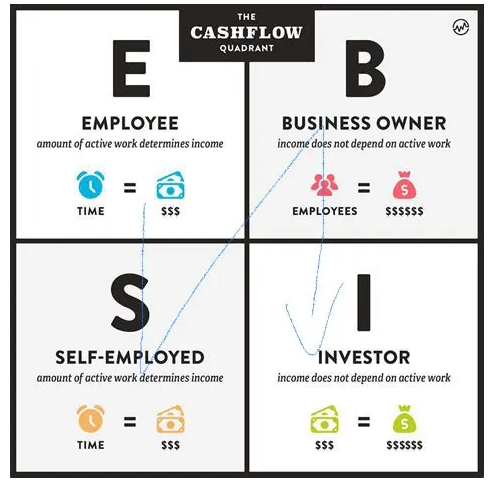
From exchanging time for money (E & S) into creating a system of value creation harnessing the power of capital and labour through a business (B) and then finally emerging from the coordinator of labour and capital role (business manager) to the director of capital alone (I) is the logic of the capitalist system and its ultimate goal. Often referred to – erroneously imho – as „passive income“, the creation of an income producing asset requires a different set of skills, an entire upgrade of personal capabilities for an individual seeking to achieve that status. The idea that the income generated by a business asset (or an investment portfolio for that matter) can be entirely delegated or that it just evaporates, requiring no further effort or operational activity on the part of the owner is, to use a technical phrase from the financial industry, weapons-grade bullshit. Nothing could be further from the truth.
In his outstanding book „Beyond Entrepreneurship 2.0“ business professor and author Jim Collins, wrote of the need for a leader to constantly upgrade their skill levels as the organisation they are leading evolves with them. Citing the case of Ann Bakar, CEO and owner of Telecare Inc. the business she inherited from her father, the founder, he writes
Bakar needed to grow into a great leader, to scale her own capabilities right alongside the growth and scale of the company. Anne Bakar 1.0 was smart and strategic, fueled by youthful passion, with just enough leadership instinct to get Telecare moving in the right direction. But that wasn’t enough. She had to grow into Anne Bakar 2.0, then Anne Bakar 3.0. She learned how to hire great people and meld them into a cohesive team. She learned that culture does not merely support strategy, but that culture is strategy. She learned how to hire for values and temperament, not just smarts and experience. She learned how and when to delegate, and when not to. She learned how to hold her unit leaders accountable for keeping the culture vibrant at the front line. She learned how to make wise decisions that reduce short-term profits for the sake of long-term greatness. She learned how to stay calm and mitigate her impulse to take control from her people when things went wrong.
He continues later in the same chapter to write
Most great leaders don’t begin as great leaders. Sure, there are a few weird freaks of nature that seem to be born for leadership, who are fascinating to look at, like some sort of exotic bug. They’re also largely irrelevant; you simply can’t do anything about whether you’re born as one of those weird, freaky bugs. And—this is the crucial point—most exceptional leaders grow into their capabilities. Not because they want to “be” a great leader, but because they’re trying to be worthy of the people they lead. If you want the people with whom you work to improve their performance, first improve your own. If you want others to expand their capabilities, first expand your own.
Collins confines himself to the question of leadership in the context of the CEO or a similar position of executive leadership, but I contend that the highest level of capitalist responsibility is one which requires a new paradigm of leadership, not divorced from but certainly materially different from the skills and attributes necessary for successful operational leadership.
There is surprisingly little literature about the role of the owner – and how to be an outstanding one. On the one hand it doesn‘t surprise me that much given that our entrepreneurial heroes, the company builders are celebrated more for their achievements „in office“ than for the roles they play when they have shuffled off stage and handed over the reins to the next generation of managers. They are assumed to have retired and are no longer as interesting as they were previously. There are very, very few actors who have made an explicit case of evolving themselves into a pure „ownership“ and capital allocator role — Warren E. Buffett, Chairman and CEO of Berkshire Hathaway Inc. immediately springs to mind — and even fewer share their thoughts and perspectives on the unique characteristics and skills necessary to perform well in that role.
Which is where I return to Machiavelli.
Banished from court on the return of Ludovico de Medicii in the early years of the 16th Century for having served as a senior civil servant with responsibility for organising Florence’s military capabilities in the vanquished Guelfian reign, Niccolo Machiavelli was desperate to get back to work and to put his organisational and diplomatic skills in the service of his beloved City State. His ploy, which worked sort of, was to write a leadership guide book „Il Principe“ for Ludovico containing the best advice for a Renaissance Prince to secure his dominion and hopefully expand it. It is a brutally honest, no-holds-barred dissertation on the nature of man within power structures and how to manage that quantity, painting a picture of men (and women) as they are, not how we would ideally like them to be.
The Church of course hated it and banned the book when it resurfaced about 100 years later, but for all that it is still today a refreshingly direct and sensible book, which is, if you are prepared to exercise some extrapolation, highly relevant to the business „city states“ of the 21st C. My favourite passages come from his timeless advice to his Prince in determining how to select and then retain excellent „servants“ (read ‚executive leaders‘) in Chapter XXII – required reading to my mind for owners no longer operating their business assets. In it he states unequivocally that
“the choice of servants is of no little importance to a prince, and they are good or not according to the discrimination of the prince. And the first opinion which one forms of a prince, and of his understanding, is by observing the men he has around him.”
So it is that an owner can be judged immediately by the quality of the operating executive or executives (“secretaries” in Machiavelli’s terminology) they have selected, going on the explain
“and when they are capable and faithful he may always be considered wise, because he has known how to recognize the capable and to keep them faithful. But when they are otherwise one cannot form a good opinion of him, for the prime error which he made was in choosing them.”
Consequently, the choice of an owner’s CEO or managing director is of the utmost importance and cannot be taken lightly or hastily or without reference to a thoughtfully constructed set of guiding principles by which the choice is made. The owner must know themselves and be aware of the “types” by whom they are typically fascinated and their own weak spots. Entrepreneurs who are used to making decisions based on their gut instinct and intuition are prone to serious errors of judgement in this critical task.
Machiavelli then continues with his litmus test for a “good secretary“
“But to enable a prince to form an opinion of his servant there is one test which never fails; when you see the servant thinking more of his own interests than of yours and seeking inwardly his own profit in everything.”
On the other hand Machiavelli warns an excellent owner/prince has some critical obligations of his own to fulfil and that
“to keep his servant honest the prince ought to study him, honouring him, enriching him, doing him kindnesses, sharing with him the honours and cares; and at the same time let him know that he cannot stand alone, so that many honours may not make him desire more, many riches make him wish for more and that many cares may make him dread chances.“
The catalogue of activities that the prince must perform continuously in order to “keep his servant honest” and motivated to always keep his own interests front and centre in his secretary’s mind appears short but requires constant vigilance and strategic effort to maintain. Taking Machiavelli’s verbs at face value, we might ask what sort of activities constitute the program of an owner determined to be worthy of having an outstanding secretary as steward of his business interests? Here is my – certainly not exhaustive -checklist of the actions and the program packed into those simple verbs listed by Machiavelli as critical
Even a cursory glance at this list shows that ownership is far from a „passive“ role, but that it comprises an entirely different schedule of activities to those of the executive leader or managing director. My own belief is that a better understanding of the role and responsibilities of business ownership would make for both better businesses whilst founders and business builders work towards that goal and much better transitions and business longevity as they embrace the fact that between active operational leadership and retirement there is a rich and deeply rewarding role waiting for them, one that represents the highest goal of our free market system, namely the conquering of time as a constraint to a fulfilled and productive life.
A previous version of this was originally published in Pitchfork Papers.